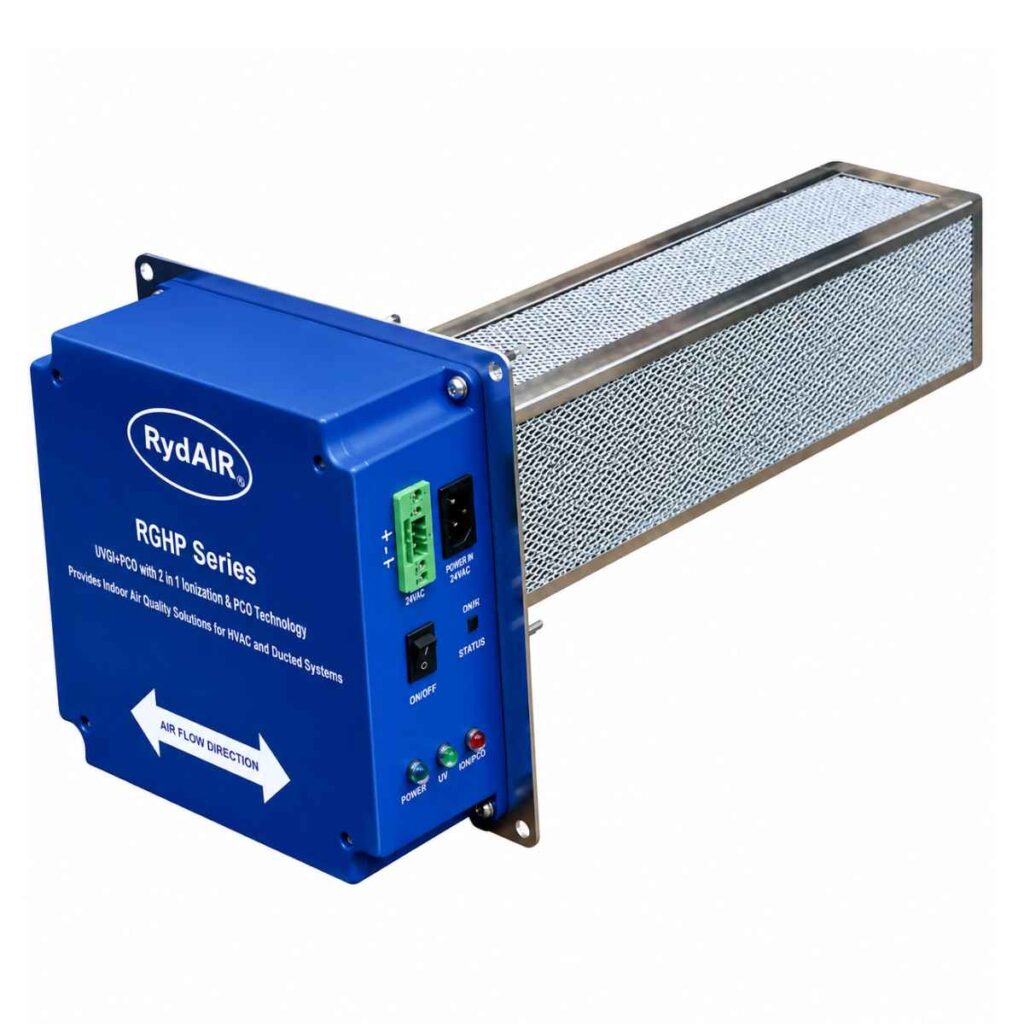
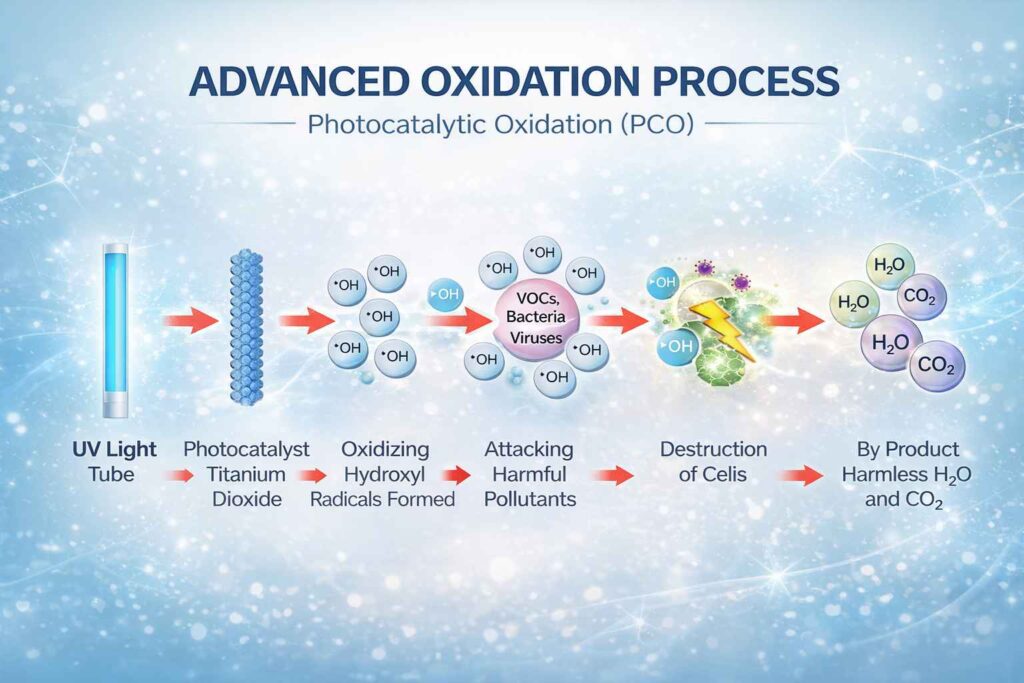
Photo Catalytic Oxidization (PCO) uses the concept of photocatalysis where the core principle involves using a UV light source and a catalyst of rare metals to break down pollutants. Variations of this process is sometimes referred as Radiant Catalytic Ionization (RCI), Dry Hydrogen Peroxide (DHP), Advanced Oxidization Process (AOP) and Natural Catalytic Conversion (NCC).
The special UV lamp reacts with photocatalyst impregnated with rare materials in the RHP units and converts moisture/ water vapour (H2O) and oxygen O2 in the untreated air and breaks them up into hydroperoxides (H2O2) and Hydroxyls which are highly reactive.
These hydroxyl radicals are small and agile and gets pushed into the environment where they attack bigger organic pollutant molecules like fungi, mould, odour causing bacteria, molds, VOCs and viruses, even the ones in hard to reach places, breaking apart their chemical bonds and turning them into harmless substances such as carbon dioxide and water.
It is proven to reduce up to 99% of surface microorganisms and dramatically reduce airborne contaminants and allergens in the air and allergens in the air.
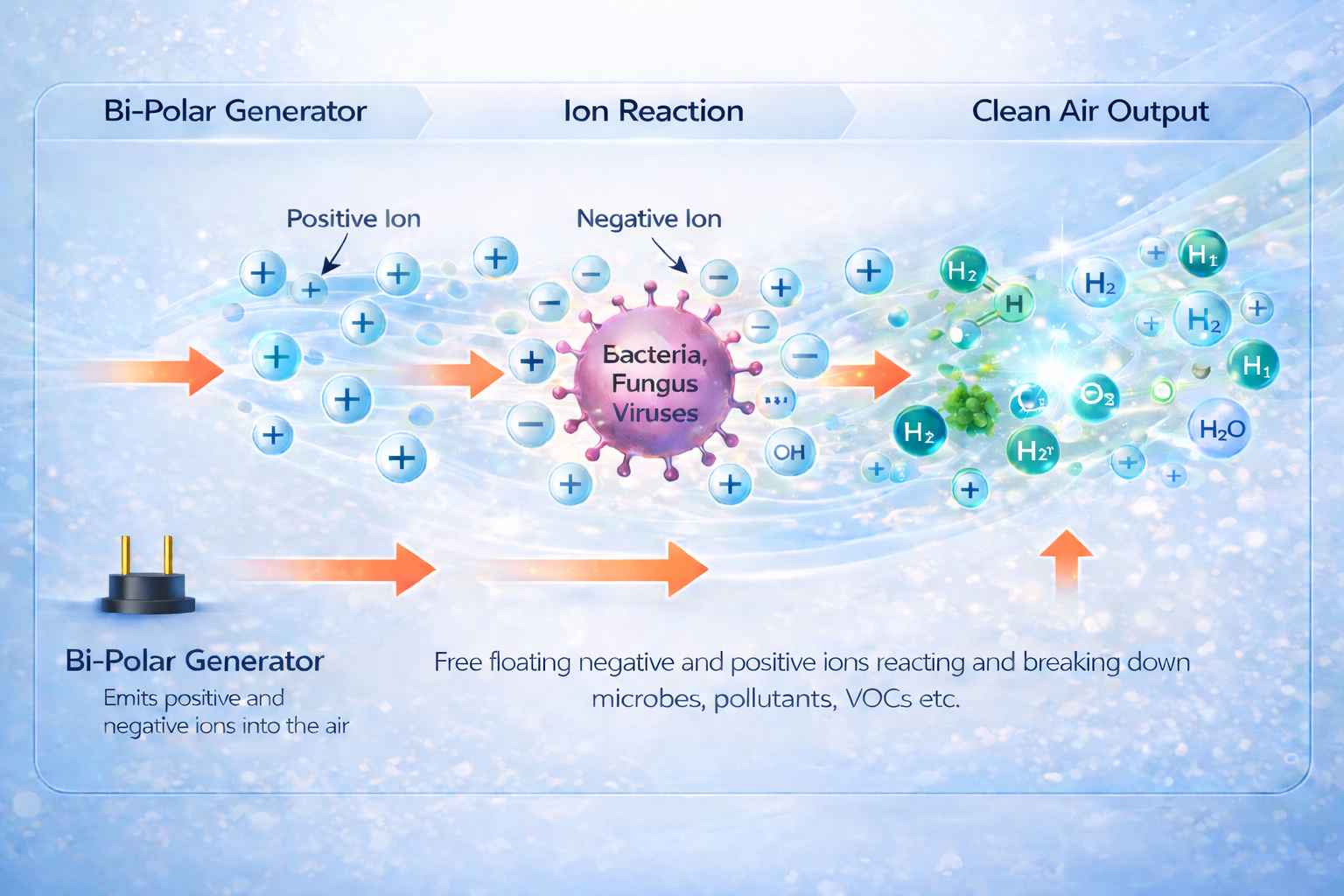
The Needlepoint Bipolar Ionization (BPI) process releases large amounts of negative and positive ions. These ions are forced out through the building HVAC system and travel into spaces throughout the building. These ions attach to, and deactivate harmful substances like bacteria, mould, allergens, viruses and volatile organic compounds, odours, VOCs including formaldehyde.
BPI has been used in Europe since the 1970s and was used originally to control pathogens in food manufacturing and storage.
Bi-Polar ionisation has already been proven as effective against various influenza strains as well as norovirus, SARs and other corona virus like H1N1 and Covid 19.
VOCs Removal – The free floating ions breaks down ammonia molecules NH3 and other VOCs, converting them into water and nitrogen, harmless common gasses that are prevalent in our atmosphere.
Airborne Particle Removal – The ions also attach to expelled droplets and dust particles that can transport viruses, enlarging them in a process called agglomeration, making them drop out of breathing area and also which them easier to be caught in the filters.
Eliminate Surface-bound Germs
Eliminate Airborne Germs
Freshen Indoor Air
Eliminate Airborne Allergens
| Models | RHP 1800B | RHP 3501B | RHP 5001B | RHP 15001B |
|---|---|---|---|---|
| Type | Ozone Free | Ozone Free | Ozone Free | Ozone Free |
| Power | 230VAC 0.10A 12W | 230VAC 0.12A 16W | 230VAC 0.15A 20W | 230VAC 0.15A 23W |
| Weight | 1.2 Kg | 1.3 Kg | 1.4 Kg | 1.5 Kg |
| High Pollution | 2500 CMH | 4000 CMH | 6000 CMH | 15,000 CMH |
| Low Pollution | 5000 CMH | 10,000 CMH | 15,000 CMH | 36,000 CMH |